The Evolution from CRM to “Smart CRM”
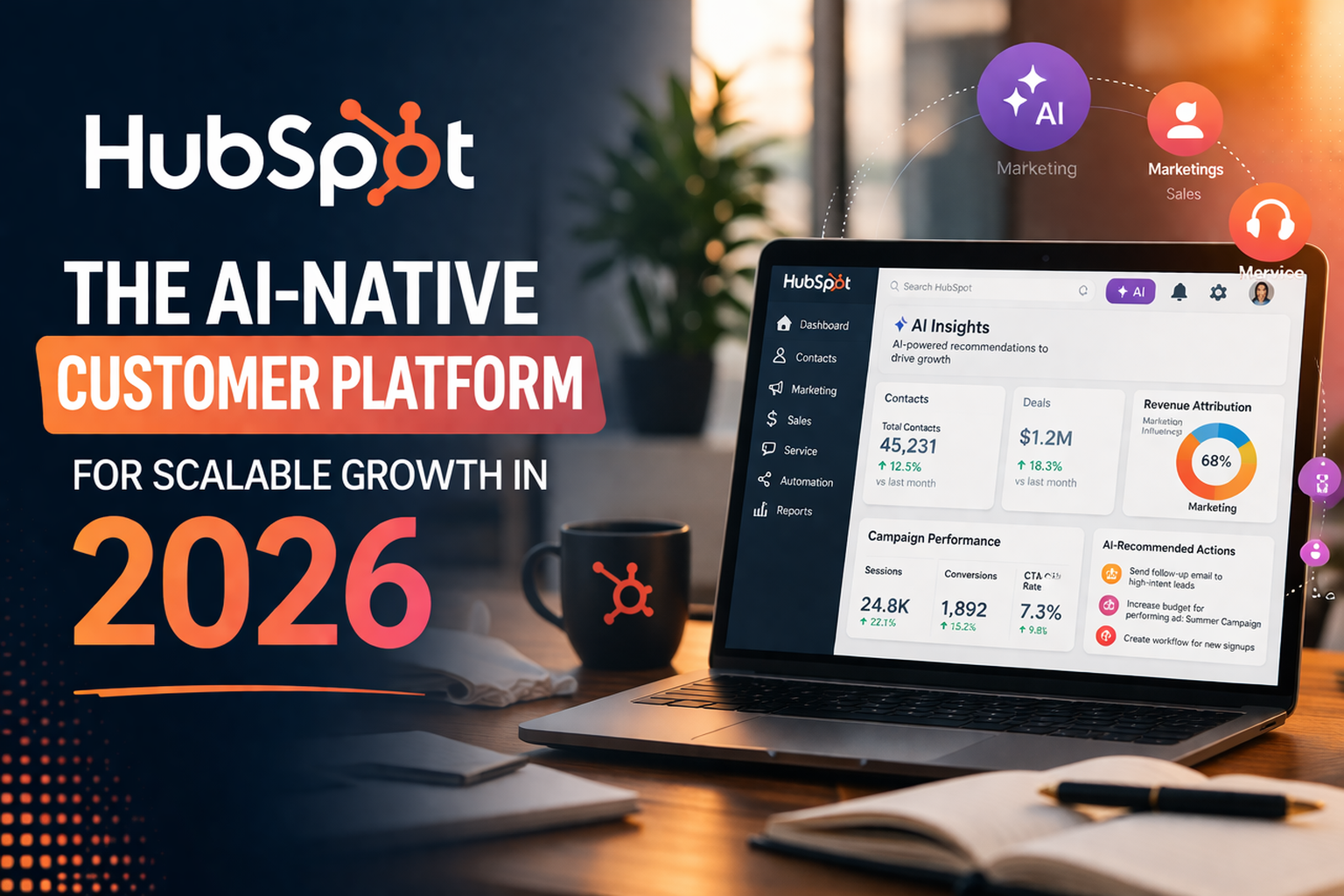
In the early 2020s, HubSpot was widely known as the “friendly alternative” to Salesforce—a simplified, all-in-one marketing and sales tool for mid-market businesses. Fast forward to 2026, and that narrative has fundamentally changed. HubSpot is no longer just an “all-in-one” suite; it has transformed into an AI-Native Customer Platform powered by what the company calls the Smart CRM.
As B2B buying cycles become more complex and traditional lead generation tactics (like cold emailing and generic SEO) lose their effectiveness, HubSpot has pivoted to solve the modern challenge: Context. In 2026, the winner isn’t the company with the most data, but the company that can use AI to turn that data into personalized, human-centric experiences at scale.
This guide provides an exhaustive look at the HubSpot ecosystem in 2026, covering the revolutionary Breeze AI suite, the new Data Hub, and how businesses are using the platform to drive revenue in an AI-first world.
1. The Core Pillar: The Smart CRM & Unified Data
At the heart of every HubSpot portal is the Smart CRM. Unlike legacy CRMs that function as glorified digital Rolodexes, the Smart CRM is a unified database that serves as the “single source of truth” for every department.
Why “Unified” Matters in 2026
In a fragmented tech stack, your Marketing team might see a lead’s website visits, while Sales sees their call history, and Support sees their open tickets. If these data points don’t talk to each other, the customer receives a disjointed experience.
HubSpot’s Smart CRM ensures that:
- Context is Global: When a Sales Rep picks up the phone, they can see exactly which AI-generated content the prospect engaged with 10 minutes ago.
- Custom Objects: Businesses can now model their CRM exactly how they operate—whether that’s tracking “Subscriptions,” “Shipments,” or “Properties”—without needing a developer to hard-code the database.
- Data Quality AI: The CRM now includes native AI that automatically deduplicates records, fixes formatting issues (like capitalized names), and alerts admins to “dirty data” before it ruins a campaign.
2. The Breeze AI Revolution: Meet Your New AI Teammates
The biggest announcement of the last year was the launch of Breeze, HubSpot’s unified AI suite. By 2026, Breeze has moved past being a “feature” and is now an integrated layer across the entire platform.
A. Breeze Assistant
Breeze Assistant is the conversational interface available to every HubSpot user. It functions as a GTM (Go-To-Market) expert that lives in your sidebar. You can ask it to:
- “Summarize the last three meetings with the Acme Corp account.”
- “Draft a follow-up email based on our brand voice and the prospect’s LinkedIn profile.”
- “Which of my deals are most likely to close this month based on historical patterns?”
B. Breeze Agents (The “Role-Based” AI)
HubSpot has introduced specialized AI Agents that act as autonomous members of your team:
- The Prospecting Agent: This agent researches companies and finds high-value leads that match your Ideal Customer Profile (ICP). It doesn’t just “scrape”; it analyzes buyer intent signals to tell you when to reach out.
- The Content Agent: More than a blog writer, this agent creates entire multi-channel campaigns. It can take a single case study and turn it into a blog post, a LinkedIn series, and a nurturing email sequence—all while maintaining consistent messaging.
- The Customer Agent: In 2026, this agent handles 50–80% of routine customer support inquiries. Because it is connected to your CRM and Knowledge Base, it provides personalized answers (like “Your order #123 is currently in Chicago”) rather than generic FAQs.
- The Data Agent: This agent acts as a proactive database admin, identifying inconsistencies and enriching records with missing information automatically.
3. Deep Dive into the Hub Ecosystem
HubSpot is organized into “Hubs,” each catering to a specific business function. In 2026, these Hubs have been redesigned to support “The Loop”—HubSpot’s new growth playbook that focuses on the continuous cycle of Attract, Engage, and Delight.
Marketing Hub: From Volume to Value
Marketing in 2026 is no longer a numbers game. With search engines prioritized by AI (AEO – Answer Engine Optimization), Marketing Hub has evolved:
- Content Remix: Take one video and automatically “remix” it into social clips, blog drafts, and ad copy.
- Journey Automation: A visual builder that allows you to create hyper-personalized paths for customers based on their real-time behavior.
- Advanced Attribution: Finally solve the “which half of my marketing budget is wasted” problem with AI-powered multi-touch attribution that counts both digital and offline touchpoints.
Sales Hub: The Modern Seller’s Cockpit
Sales Hub has moved away from manual data entry.
- Lead Scoring 2.0: Uses machine learning to predict which leads will convert based on thousands of data points, not just “clicks.”
- Sales Playbooks: Interactive scripts and checklists that pop up for reps during calls, ensuring they hit every key value proposition.
- Embedded Video: Sales reps can now record and send personalized AI-enhanced videos directly from the CRM to increase engagement.
Service Hub: Deflection and Delight
The goal of Service Hub in 2026 is to solve problems before the customer even asks.
- Predictive Support: AI identifies customers who are exhibiting “churn behavior” (like low app usage) and alerts the Success team to intervene.
- Unified Omni-channel Inbox: Manage WhatsApp, Facebook, Email, and SMS in one place with a single view of the customer.
The New Data Hub (Formerly Operations Hub)
Replacing the old Operations Hub, the Data Hub is the powerhouse for RevOps (Revenue Operations). It features Data Studio, a spreadsheet-style interface that allows ops teams to connect external data warehouses (like Snowflake or BigQuery) directly into HubSpot without complex middleware.
4. Understanding the 2026 Pricing Model
HubSpot’s pricing has evolved to reflect the value of its AI capabilities. The model now relies on a combination of Seats, Contacts, and HubSpot Credits.
The Credit System
AI actions (like generating a 2,000-word article or enriching a list of 500 prospects) now consume HubSpot Credits.
- Starter: Includes 500 credits/mo.
- Professional: Includes 5,000 credits/mo.
- Enterprise: Includes 10,000+ credits/mo.
Tiers at a Glance (Estimates for 2026)
| Tier | Pricing Starting At | Best For |
| Free | $0 | Solopreneurs and very small startups. |
| Starter | ~$15-20 / seat / mo | Teams needing basic automation and professional branding. |
| Professional | ~$800-1,300 / mo | Scaling businesses needing AI Agents and advanced reporting. |
| Enterprise | ~$3,600-4,700 / mo | Complex organizations requiring sandboxes, SSO, and custom objects. |
5. HubSpot vs. Salesforce: The 2026 Verdict
The “HubSpot vs. Salesforce” debate remains, but the gap has narrowed in capability while widening in philosophy.
- Salesforce remains the choice for massive, highly customized global enterprises that need extreme “lego-block” flexibility and have massive developer budgets.
- HubSpot has become the “Apple” of the CRM world. It is powerful, sophisticated, and can handle billion-dollar companies, but it prioritizes Usability and Fast Time-to-Value. In 2026, most mid-market and fast-growing SaaS companies prefer HubSpot because they can go from “sign-up” to “revenue-generating” in weeks, not months.
6. Implementation Strategy: Setting Up for Success
To maximize your ROI in HubSpot for 2026, follow these three strategic steps:
- Prioritize the Data Foundation: Don’t turn on AI agents until your data is clean. Use the Data Agent to audit your current records first.
- Define Your Brand Voice: Breeze AI works best when it knows how you sound. Take the time to set up the “Brand Identity” settings in the Content Hub.
- Invest in RevOps: HubSpot is so powerful that it can become a mess without someone “owning” the platform. Hire a RevOps specialist or partner with an agency to ensure the hubs are communicating correctly.
Conclusion: The Future of Your Customer Experience
HubSpot has successfully navigated the transition into the AI era. By focusing on a unified database and role-based AI Agents, they have created a platform that doesn’t just “track” customers—it helps you grow with them.
Whether you are a startup looking for your first CRM or an enterprise looking to consolidate your “SaaS Sprawl,” HubSpot’s 2026 ecosystem offers the most cohesive and future-proof solution on the market.