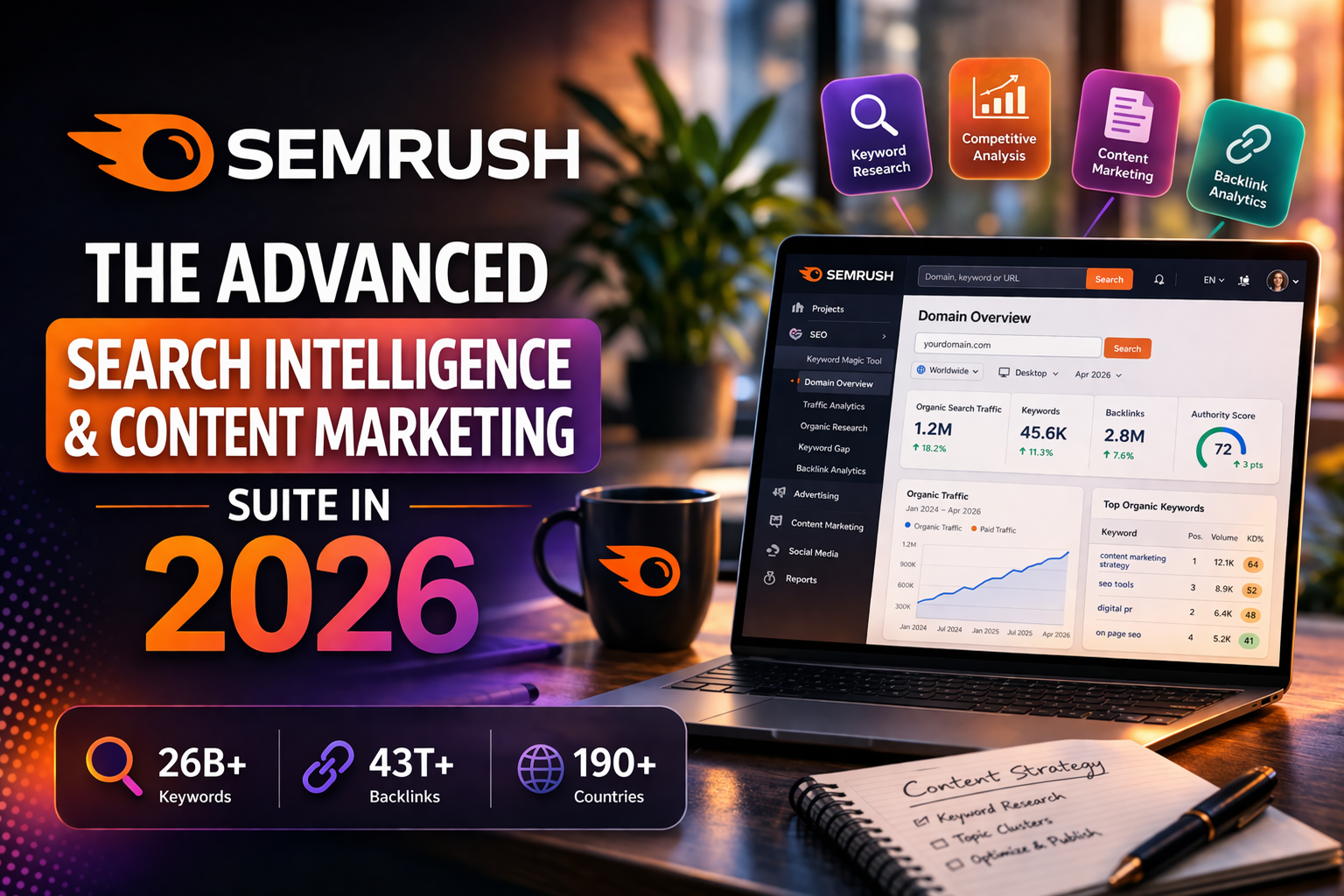
Navigating the Era of “AI Visibility”
In 2026, the digital marketing landscape has undergone a seismic shift. Traditional SEO—optimizing for blue links on a search results page—is no longer enough. We now live in the world of AEO (Answer Engine Optimization) and AI Visibility. Modern users aren’t just clicking links; they are receiving synthesized answers from ChatGPT, Google’s AI Mode (formerly SGE), and Perplexity.
Semrush has evolved ahead of this curve. Once a “keyword research tool,” it is now a comprehensive Search Intelligence Platform. For businesses in 2026, Semrush provides the data necessary to ensure your brand isn’t just “ranking,” but is being cited by the AI models that customers trust.
This 2,000-word guide breaks down the massive Semrush ecosystem in 2026, from its core SEO roots to the revolutionary AI Visibility Toolkit and the ContentShake AI suite.
1. The 2026 SEO Powerhouse: More Than Just Keywords
While Semrush has added dozens of AI features, its “bread and butter” remains its massive data index. As of 2026, Semrush maintains a database of over 28 billion keywords and 43 trillion backlinks.
Keyword Magic Tool: The Gold Standard
The Keyword Magic Tool remains the industry’s most powerful engine for discovery. In 2026, it now includes:
- Search Intent Classification: Automatically labels every keyword as Informational, Navigational, Commercial, or Transactional.
- Personalized Difficulty (PKD%): A new 2026 metric that calculates how hard it will be for your specific domain to rank for a keyword, based on your existing topical authority.
- Topic Cluster Mapping: One-click generation of “Pillar and Cluster” maps, showing you exactly how to group content to dominate a specific niche.
Site Audit: The Technical Health Check
The Semrush Site Audit tool in 2026 is faster and more intuitive. It scans for over 140 technical issues, including the latest Core Web Vitals and AI Crawlability—a new check that ensures AI bots (like OpenAI’s GPTBot) can successfully ingest and understand your site’s content.
2. Content Marketing: From Strategy to Execution with AI
The most significant growth in the Semrush platform has been in its Content Marketing Toolkit. In 2026, the goal is to reduce the time from “idea” to “published post” by 90%.
Topic Research & Cluster Builder
Instead of guessing what to write about, the Topic Research tool analyzes the “mindshare” of your audience. In 2026, it can identify “Trending Micro-topics” before they hit the mainstream, giving you a first-mover advantage. The Cluster Builder then takes these topics and organizes them into a content strategy that Google’s 2026 algorithms reward.
ContentShake AI: Your 2026 Writing Assistant
ContentShake AI is Semrush’s answer to the demand for high-quality, SEO-optimized AI writing. Unlike generic LLMs, ContentShake is “SEO-Aware.”
- Data-Backed Briefs: It scans the top 10 competitors for your target keyword and builds a brief that includes the optimal word count, H2/H3 structure, and semantic (LSI) keywords.
- AI Article Generation: It can draft a 2,000-word article in seconds. However, in 2026, it includes a “Brand Voice” filter that prevents the content from sounding “robotic.”
- Direct WordPress Publishing: Once the article is ready, you can push it directly to your WordPress site with a single click, including all meta-data and AI-generated images.
3. The AI Visibility Toolkit: The Future of Tracking
Perhaps the most innovative addition to Semrush in 2026 is the AI Visibility Toolkit. This tool solves the “Black Box” problem of AI search.
Monitoring AI Mentions
Traditional “Position Tracking” tells you if you are #1 on Google. AI Visibility Tracking tells you:
- Citations: Is ChatGPT or Google AI citing your URL as a source for its answer?
- Sentiment Analysis: Is the AI’s “opinion” of your brand positive, neutral, or negative?
- Share of Voice: In a given niche, how often is your brand mentioned compared to competitors in AI-generated responses?
This data is crucial for 2026 CMOs who need to report on brand health in a world where “clicks” are declining but “brand mentions” in AI apps are skyrocketing.
4. Advertising and PPC: Dominating Paid Search
Semrush continues to outperform competitors like Ahrefs in the Advertising Toolkit. For businesses running Google Ads or Meta Ads, Semrush provides a “window” into competitor spend and strategy.
- Ads History: See the exact ad copies and landing pages your competitors have used over the last 5 years.
- PPC Keyword Tool: Optimize your ad spend by identifying “low-competition, high-conversion” keywords that your competitors are overlooking.
- PLA (Product Listing Ads) Research: Essential for E-commerce brands in 2026 to see how competitors are pricing and positioning products in Google Shopping.
5. Pricing Plans: Semrush in 2026
In 2026, Semrush offers two main pathways: the SEO Classic plans and the new Semrush One (AI-integrated) plans.
SEO Classic Plans
| Plan | Monthly Cost | Best For |
| Pro | $139.95 | Solopreneurs and small in-house teams. |
| Guru | $249.95 | Agencies and mid-sized businesses (Includes Content Marketing Suite). |
| Business | $499.95 | Large enterprises requiring API access and high limits. |
The “Semrush One” Evolution
The Semrush One plans are the flagship offerings of 2026. They bundle the Classic SEO tools with the AI Visibility Toolkit and ContentShake AI.
- Starter: $199/mo
- Pro+: $299/mo (The “sweet spot” for most businesses)
- Advanced: $549/mo
6. Competitive Analysis: Semrush vs. Ahrefs in 2026
The rivalry continues, but the use cases have diverged:
- Choose Ahrefs if: You are an SEO purist focused exclusively on backlink profiles and technical link-building. Ahrefs’ “Site Explorer” remains a favorite for its UI and “Parent Topic” features.
- Choose Semrush if: You need a “Full-Stack” marketing suite. If you do SEO, Content, PPC, and Social Media, Semrush provides significantly more value for the price. In 2026, Semrush’s AI integration is also significantly more advanced than Ahrefs’.
7. Implementation: Getting the Most Out of Semrush
To avoid being overwhelmed by Semrush’s 50+ tools, 2026 power users follow this workflow:
- The Weekly Audit: Set up an automated Site Audit and Position Tracking report to catch technical “leakage” every Monday.
- The Keyword Gap: Use the Keyword Gap tool to see where competitors are outranking you and use ContentShake AI to quickly draft “gap-filler” content.
- Local SEO: If you have physical locations, the Listing Management tool in Semrush is non-negotiable for keeping your “Google Maps” and “Apple Maps” data synced.
- Social Media Poster: Use the built-in scheduler to repurpose your blog content into social posts automatically.
Conclusion: The Integrated Future
Semrush in 2026 is no longer just a luxury for SEO specialists; it is an essential piece of infrastructure for any business that wants to be found online. By bridging the gap between “Old SEO” (keywords and links) and “New Search” (AI visibility and content clusters), Semrush has secured its place as the definitive digital marketing operating system.
If you are looking to scale your organic presence while keeping a pulse on the rapidly changing AI landscape, there is no more comprehensive tool than Semrush.