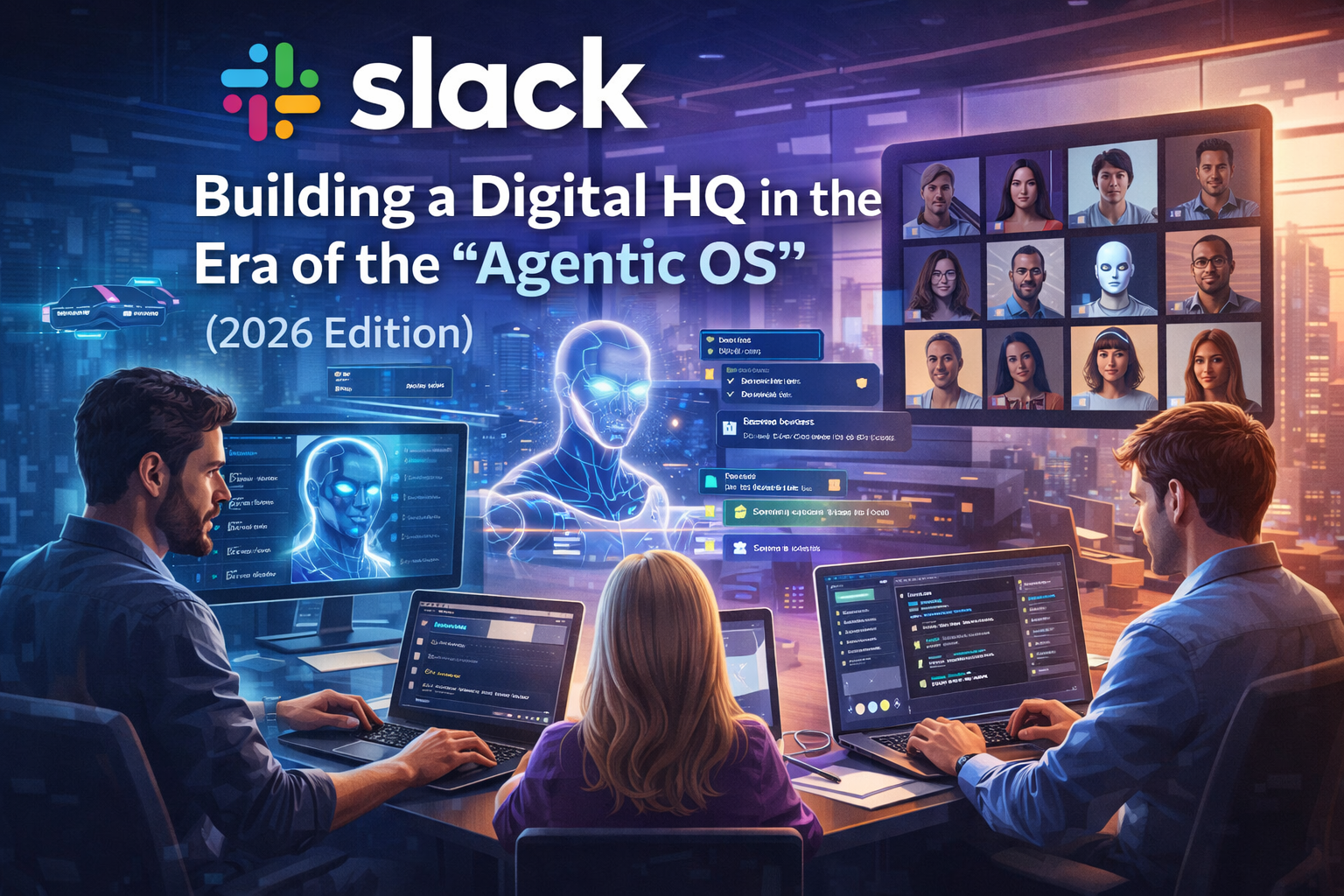
From Messaging App to Agentic Operating System
In the early 2010s, Slack was the “email killer.” By 2020, it was the “Digital HQ.” As we navigate 2026, Slack has undergone its most profound transformation yet: it has become the Agentic Operating System (OS) for Work.
In the modern enterprise, work no longer happens in a single window. It is scattered across CRMs, cloud storage, project management tools, and specialized AI models. The 2026 version of Slack serves as the “intelligent fabric” that connects these disparate threads. It is no longer just a place where people talk about work; it is the place where human-AI teams execute work.
With the deep integration of Salesforce Agentforce, the launch of Enterprise Search, and the maturation of Slack AI, this platform has solidified its position as the conversational interface for the modern business. In this 2,000-word guide, we explore why Slack remains the gold standard for collaboration in 2026.
1. Slack AI: Reclaiming Your Time
The most immediate value for Slack users in 2026 comes from Slack AI. This isn’t a separate tool you have to “go to”; it is a native intelligence layer that lives inside your channels and DMs, designed to eliminate the “information overload” that defined the last decade.
Channel Recaps and Thread Summaries
Gone are the days of scrolling through 200 unread messages after a long weekend.
- Channel Recaps: With one click, Slack AI generates a structured summary of everything that happened in a channel over a specific period. It identifies key decisions made, items still pending, and who was involved.
- Thread Summaries: If a specific conversation thread has branched into 50 replies, Slack AI provides a “TL;DR” that extracts the main points, allowing you to jump in only if your input is actually needed.
AI-Powered Search with Citations
Search in 2026 is no longer about finding “keywords”; it’s about getting “answers.”
When you ask a question in the search bar—e.g., “What is our current strategy for the Q3 product launch?”—Slack AI doesn’t just show you a list of messages. It synthesizes an answer from your messages, files, and even connected apps (like Google Drive or Jira), providing direct citations so you can verify the source of the information.
2. The Agentic Revolution: Teaming Up with Agentforce
The biggest shift in 2026 is the introduction of AI Agents as teammates. Through the Agentforce in Slack integration, AI is no longer a passive assistant; it is a proactive participant in your channels.
What is an AI Agent in Slack?
An AI Agent is a specialized digital entity that can understand natural language, reason through tasks, and execute actions across different software systems.
- The SDR Agent: Lives in your sales channel. It monitors new leads in Salesforce, researches their LinkedIn profiles, and drafts a personalized intro message in Slack for the human rep to approve.
- The Support Agent: Swarms on a customer issue in a dedicated channel, pulling in relevant documentation and suggesting a resolution based on similar past cases.
- The “Perplexity Push” Agent: Automatically scours the web for news related to your competitors and posts a daily “Intelligence Brief” into your #market-trends channel.
Agentic Workflows
Using the Workflow Builder, anyone can now create “Agentic Workflows” without writing code. You can set triggers like “When a deal in Salesforce moves to ‘Closed-Won’…” and the Agent will automatically create a new project channel, invite the right stakeholders, and post a celebratory summary of the deal’s history.
3. Slack Canvas & Huddles: The Visual and Spontaneous Layer
To combat the “ephemeral” nature of chat, Slack introduced Canvas and Huddles, which have reached their full potential in 2026.
Slack Canvas: The Persistent Surface
Every channel and DM now has a Canvas—a persistent, editable document that lives alongside the conversation.
- Live Dashboards: In 2026, you can embed live Salesforce reports or Tableau charts directly into a Canvas. These aren’t static screenshots; they update in real-time.
- Onboarding Hubs: Teams use Canvases to store “Mission Critical” links, project briefs, and FAQ lists, ensuring that new team members have a single source of truth without searching.
Huddles 2.0: Spontaneous Video & AI Notes
Huddles have replaced scheduled Zoom meetings for many 2026 teams.
- Lightweight Video: One-click audio and video sessions that feel less formal than a “meeting.”
- Auto-Generated Minutes: When a Huddle ends, Slack AI automatically posts a summary of the discussion and a list of “Action Items” into the channel, tagged to the relevant people.
4. The Salesforce “Front Door”
Since the acquisition by Salesforce, the “Salesforce-Slack” integration has become the “killer app” for enterprise sales and service teams. In 2026, Slack is effectively the UI for the CRM.
- No-Context Switching: Reps can update Opportunity stages, log notes, and create new leads directly from a Slack message.
- Einstein Copilot: You can message “Einstein” in Slack to ask for a pipeline forecast or to identify which accounts are “at-risk” based on recent sentiment analysis of support tickets.
- Salesforce Channels: Dedicated channels that are automatically synced with specific CRM records, ensuring that the “Sales-to-Service” handoff is seamless.
5. Security and Governance at Scale
For large organizations, 2026 is the year of Enterprise Grid. Slack has solved the security concerns of the early “shadow IT” days.
- Slack Connect: Allows you to collaborate with up to 250 external organizations (vendors, partners, clients) in a single secure channel, eliminating the need for guest accounts and insecure email chains.
- Enterprise Search: A new 2026 feature that allows admins to search across the entire organization’s knowledge base—including files in Box, OneDrive, and GitHub—all while respecting strict permission and compliance layers.
- Data Residency: Slack now offers granular data residency options, allowing global companies to store their data in specific regions to comply with local laws (GDPR, CCPA, etc.).
6. Pricing and Value: The 2026 Tiers
Slack’s pricing has shifted to reflect its AI-first focus. Most businesses in 2026 find the most value in the Business+ tier.
| Plan | Est. 2026 Price | Best For | Key AI Features |
| Free | $0 | Small teams / Startups | 90-day history, 1:1 Huddles. |
| Pro | ~$7.25 / user / mo | Scaling businesses | Unlimited history, Group Huddles. |
| Business+ | ~$15 / user / mo | Mid-market enterprises | Full Slack AI Suite, SAML SSO, 99.99% SLA. |
| Enterprise+ | Custom | Global Leaders | Agentforce, Enterprise Search, Compliance. |
7. Slack vs. Microsoft Teams: The 2026 Verdict
The “Battle of the Platforms” is more distinct than ever in 2026:
- Choose Microsoft Teams if: You are a “Microsoft House” heavily reliant on Excel, SharePoint, and deep IT governance. Teams is often “free” (bundled), making it the budget-conscious choice for large, traditional corporations.
- Choose Slack if: You value Productivity and User Experience. Slack remains the favorite of developers, creative agencies, and fast-moving tech companies because of its superior mobile app, extensive 3rd-party integration library (2,600+ apps), and intuitive AI experience. In 2026, Slack is widely considered the more “joyful” and efficient platform for actual daily work.
8. Implementation: Best Practices for 2026
To avoid “Slack Fatigue” and maximize the AI’s potential, follow these three rules:
- Enforce a “Channel-First” Policy: Move away from DMs. Public channels allow the AI to learn and provide better search results for the whole team.
- Prune Your Apps: Don’t just add every app. Focus on deep integrations like Jira, Google Calendar, and Salesforce that actually trigger automated workflows.
- Use the “Digest” Feature: Instead of muting noisy channels, use Slack AI to generate a daily “Digest” of them so you stay informed without being interrupted.
Conclusion: The Culture of Connection
Slack in 2026 is more than a utility; it is a cultural cornerstone. By reducing the “noise” through AI summarization and increasing the “speed” of execution through AI agents, Slack has moved humanity’s focus back to where it belongs: Creativity and Connection.
In a world where AI can write the code and organize the data, the true value of a company lies in how its people (and their AI teammates) collaborate to solve problems. Slack is the playground where that collaboration happens.