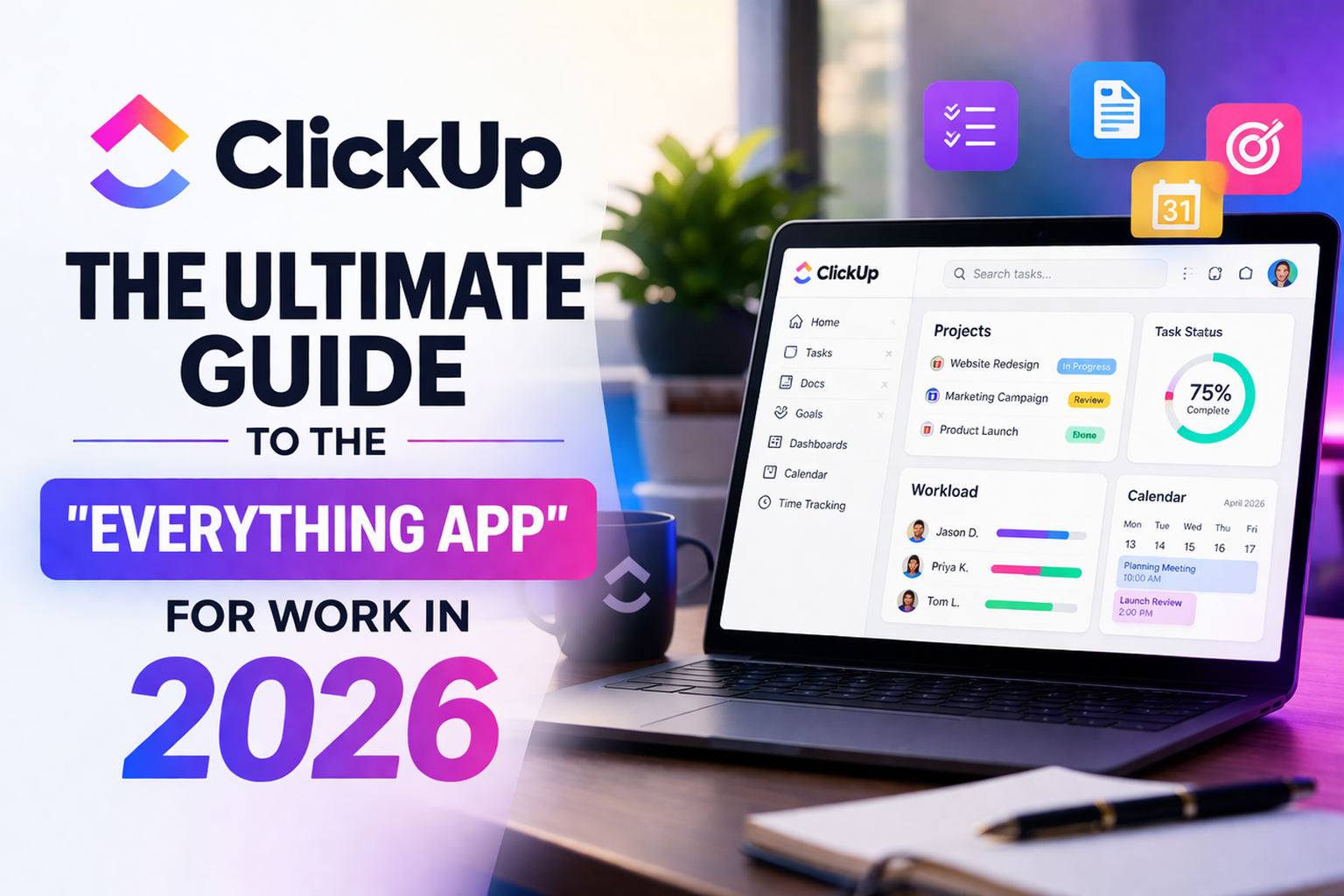
Solving the “SaaS Sprawl” Problem
In 2026, the average enterprise uses over 130 different SaaS applications. This phenomenon, known as “SaaS Sprawl,” has led to fragmented data, lost productivity, and “context switching” fatigue. Enter ClickUp, the software that famously promises to “save you one day every week.”
While many project management tools focus on a single niche—like task tracking or document storage—ClickUp has positioned itself as the central nervous system of the modern business. By 2026, it has evolved from a simple productivity tool into a sophisticated, AI-driven platform that integrates tasks, docs, whiteboards, goals, and even CRM capabilities into a single interface.
In this deep-dive guide, we will explore why ClickUp remains a market leader, how its 2026 AI updates are changing the game, and whether it’s the right fit for your organization.
1. The Core Architecture: One App to Rule Them All
The beauty of ClickUp lies in its hierarchical structure, which provides a level of organization that rivals like Trello or Asana often lack. This structure allows for both high-level executive oversight and granular task management for individual contributors.
The ClickUp Hierarchy
- Workspaces: The highest level, usually representing your entire company.
- Spaces: Large departments (e.g., Marketing, Engineering, HR).
- Folders: Specific projects or initiatives.
- Lists: The “containers” for your tasks.
- Tasks: The actionable items, complete with subtasks, nested subtasks, and checklists.
This hierarchy is essential for 2026 businesses that need to manage complex, cross-functional projects without losing sight of the “Big Picture” goals.
2. ClickUp Brain: The AI Engine of 2026
As of 2026, the standout feature of the platform is ClickUp Brain. This isn’t just a chatbot tacked onto a side panel; it is a deeply integrated neural network that understands your entire Workspace.
Key Capabilities of ClickUp Brain:
- AI Knowledge Manager: You can ask ClickUp Brain any question about your company’s data. “What is our current policy on remote work stipends?” or “What did the client say about the budget in last week’s meeting?” It scans your Docs, Tasks, and even integrated Slack messages to give you an answer instantly.
- AI Project Manager: It can automatically generate status reports, identify bottlenecks in your workflow, and even predict if a project is likely to miss its deadline based on historical team velocity.
- AI Writer for Work: ClickUp Brain helps draft emails, blog posts, and technical requirements (PRDs). In 2026, it now includes “brand voice” training, ensuring the AI writes exactly like your marketing team.
3. Beyond Tasks: Docs, Whiteboards, and Dashboards
To truly eliminate other apps, ClickUp has built world-class versions of the tools you usually pay extra for.
ClickUp Docs (The Notion Killer)
ClickUp Docs are no longer just text files. In 2026, they feature real-time collaboration, bi-directional linking, and the ability to embed live tasks directly within the text. If you update a task status in a Doc, it updates everywhere else in the Workspace.
ClickUp Whiteboards
For creative brainstorming, Whiteboards offer a canvas where you can draw, add sticky notes, and—most importantly—convert any shape into a ClickUp task. This bridges the gap between “ideation” and “execution.”
Real-Time Dashboards
Dashboards provide the “Mission Control” view. Using over 50 “widgets,” managers can track everything from team workload and sprint progress to time tracking and even financial profitability if using ClickUp’s CRM features.
4. Industry-Specific Use Cases in 2026
ClickUp’s flexibility is its greatest strength, making it adaptable across various industries:
- Software Development: Using the Sprints and GitHub/GitLab integrations, dev teams can manage their entire CI/CD pipeline within ClickUp.
- Marketing Agencies: Agencies use ClickUp to manage client portals. By inviting clients as “Guests” with restricted permissions, they can provide transparent updates without sharing internal communications.
- Professional Services: Consulting firms utilize the Time Tracking and Billable Rates features to ensure projects stay within budget and invoices are accurate.
5. Pricing and ROI Analysis
As of early 2026, ClickUp maintains a competitive pricing model designed to scale with your business:
| Plan | Best For | Key Features |
| Free Forever | Personal use / Solopreneurs | Unlimited tasks, 100MB storage. |
| Unlimited ($7/user/mo) | Small teams | Unlimited storage, Dashboards, Integrations. |
| Business ($12/user/mo) | Mid-sized companies | Google SSO, Custom exporting, Advanced time tracking. |
| Enterprise (Custom) | Large Organizations | White-labeling, HIPAA compliance, Dedicated Success Manager. |
Note: ClickUp Brain is typically available as an add-on for a small monthly fee per member on paid plans.
6. Pros and Cons: A Candid Look
The Pros:
- Feature Richness: You can genuinely replace 5–10 other apps.
- Customization: Custom Fields and Custom Task Statuses allow you to build any workflow imaginable.
- Automation: The “If/Then” automation engine saves hours of manual data entry.
The Cons:
- Learning Curve: Because it does so much, new users can feel overwhelmed. Proper onboarding is a must.
- Mobile App Performance: While much improved in 2026, the mobile experience still struggles to replicate the full complexity of the desktop version.
Conclusion: Is ClickUp Right for You?
ClickUp is the ideal solution for teams that are tired of jumping between tabs. If your team is struggling with communication silos and “where did I put that file?” syndrome, ClickUp is the most robust antidote available in the 2026 SaaS market.
However, if you are a very small team looking for extreme simplicity, a more “opinionated” tool like Trello or Basecamp might be faster to set up. But for those who want a platform that grows with them, ClickUp is a power-user’s dream.