The Death of the “Bot” and the Rise of the AI Agent
For over a decade, “chatbots” were the bane of customer service. They were rigid, rule-based, and often left customers frustratedly typing “speak to a human.” But as we move through 2026, that era is officially over. Zendesk has led a fundamental industry pivot from simple automated scripts to Autonomous AI Agents.
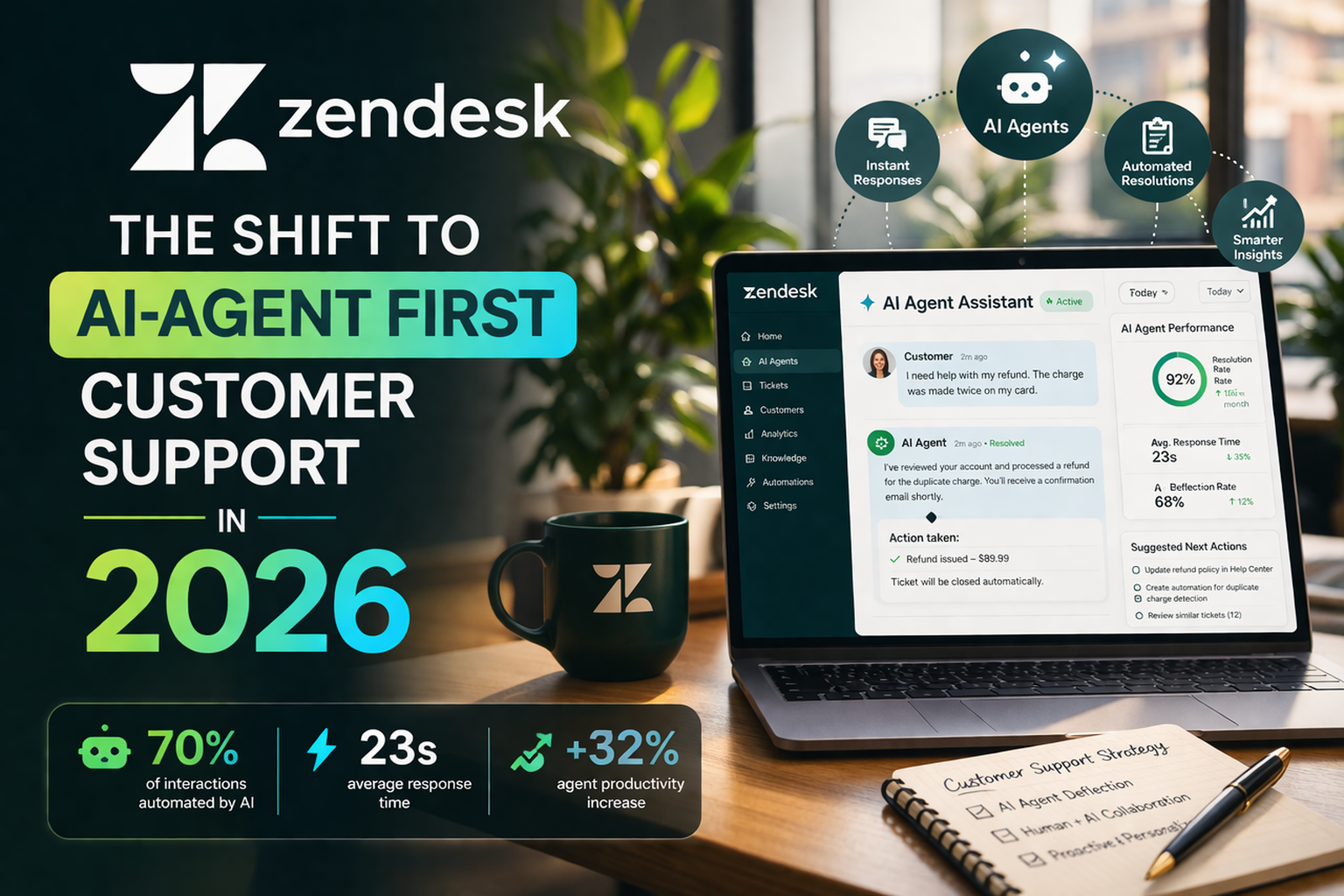
In 2026, Zendesk is no longer just a ticketing system with a bot “bolted on.” It has transitioned into an AI-First Customer Experience (CX) Platform. The platform’s philosophy has shifted: instead of AI being a tool for the agent, the AI Agent is now the first line of defense, capable of resolving complex, multi-step issues without any human intervention.
This guide explores the state of Zendesk in 2026, focusing on the revolutionary “Outcome-Based Pricing,” the new Voice AI capabilities, and how “Agent Copilot” is turning human support reps into “Super-Agents.”
1. The Architecture of 2026: The Knowledge Graph
At the core of Zendesk’s 2026 evolution is the Knowledge Graph. In previous years, bots simply “searched” a help center for keywords. Today, Zendesk’s AI understands the relationships between your products, your customers, and your policies.
How the Knowledge Graph Works:
- Semantic Understanding: The AI doesn’t just look for the word “refund.” It understands the difference between a “refund request for a broken item” and a “refund status inquiry,” triggering different workflows for each.
- External Data Ingestion: Through the new Confluence and Google Drive connectors, Zendesk AI can now ingest internal company data (that isn’t public-facing) to help agents solve internal or complex technical tickets faster.
- Automated Content Gaps: The system now identifies “Content Gaps”—questions customers are asking that don’t have an answer in your help center—and automatically drafts a suggested article for your team to approve.
2. Autonomous AI Agents: Handling Complexity
The hallmark of 2026 is the Autonomous AI Agent. Unlike the “FAQ bots” of the past, these agents are powered by advanced LLMs that can reason through problems.
Key Capabilities:
- Multiple Intent Detection: A customer might send an email saying: “I want to return my shoes, but I also lost my login, and can you tell me if the blue ones are in stock?” In 2026, Zendesk AI identifies all three intents, handles the login reset, starts the return process, and checks the inventory in one cohesive reply.
- Action Builder: Using a no-code visual interface, admins can give AI Agents “skills.” These aren’t just text replies; the AI can now execute actions like processing a refund in Shopify, updating a subscription in Stripe, or rescheduling a flight in a proprietary booking system.
- Tone and Sentiment Adjustment: The AI detects if a customer is frustrated. In 2026, it can automatically switch from an “upbeat/helpful” tone to a “conciliatory/professional” tone, or escalate immediately to a human manager if the sentiment score drops below a certain threshold.
3. Agent Copilot: Empowering the “Super-Agent”
While AI handles the routine, the role of the human agent has changed. In 2026, every human rep is equipped with Zendesk Copilot, an AI sidekick that lives within the Agent Workspace.
Copilot’s Core Features:
- Suggested Responses & Macros: Copilot drafts replies in real-time, which the agent can review and send with one click.
- Ticket Summarization: When a complex, 20-message thread is escalated to a human, Copilot provides a 3-sentence summary of the problem and the steps already taken. This eliminates the need for the agent to “read the whole history.”
- Knowledge Retrieval: Instead of searching the help center, an agent can ask Copilot: “What is the policy for shipping to Norway?” and get an instant, cited answer.
- Live Translation: In 2026, Zendesk’s Native AI Translation allows a Spanish-speaking agent to support a Japanese-speaking customer in real-time, with the AI handling the translation of both incoming and outgoing messages perfectly.
4. Voice AI: The Final Frontier of Automation
For years, phone support was the hardest channel to automate. In 2026, Zendesk’s acquisition of specialized voice technology has led to Zendesk Voice AI.
These aren’t the “Press 1 for Sales” menus of old. They are Natural Language Voice Agents that sound indistinguishable from humans. They can handle authentication (via voice biometrics), answer common questions, and even perform tasks like “change my appointment time” over the phone. If a handover to a human is needed, the human agent receives a live transcript of everything discussed so far.
5. Outcome-Based Pricing: A Paradigm Shift
The most controversial and significant change in 2026 is Zendesk’s move toward Outcome-Based Pricing.
Traditionally, SaaS was billed “per seat.” But if AI is doing 70% of the work, seat-based pricing no longer makes sense for the vendor. Zendesk now charges based on Automated Resolutions (AR).
| Pricing Component | Cost (2026 Estimates) | Description |
| Human Seat | $55 – $219 / mo | Access to the platform for human agents. |
| AI Resolution (Committed) | $1.50 / resolution | You prepay for a volume of issues solved by AI. |
| AI Resolution (On-Demand) | $2.00 / resolution | “Pay-as-you-go” for automated successes. |
What counts as a “Resolution”? A resolution is defined as a conversation where the AI Agent provides the answer and the customer does not ask for a human or reopen the ticket within 72 hours. This aligns Zendesk’s incentives with your own: they only get paid more if their AI actually works.
6. Workforce Management (WFM) and QA in the AI Era
With AI handling so much volume, managing the human workforce has become more data-driven. Zendesk now includes Zendesk WFM and Zendesk QA (formerly Klaus) as core components.
- Zendesk QA: AI now “grades” 100% of your customer interactions—both human and AI. It looks for compliance, politeness, and accuracy, identifying exactly where your human agents need coaching and where your AI Agent needs better training data.
- Predictive Forecasting: Zendesk WFM uses historical data to predict exactly how many human agents you need on a Tuesday at 2:00 PM, accounting for the “deflection rate” of your AI Agents.
7. Pros and Cons: The 2026 Verdict
The Pros:
- Scale Without Hiring: You can handle a 300% spike in Black Friday traffic without adding a single human headcount.
- Unified Ecosystem: Having CRM, Messaging, Voice, QA, and WFM in one place reduces “Toggle Tax.”
- Rapid Deployment: With pre-built “Intents” for industries like E-commerce and FinTech, you can have a basic AI Agent running in days.
The Cons:
- Cost Complexity: The combination of seat-based, add-on, and resolution-based pricing can make budgeting difficult.
- Data Preparation: The AI is only as good as your documentation. If your help center is a mess, the AI will be too.
- Technical Overhead: While “no-code,” setting up complex Action Flows still requires a logical, “developer-mindset” admin.
Conclusion: Embracing the Hybrid Model
Zendesk in 2026 represents the ultimate “Hybrid” support model. It acknowledges that while AI is now capable of handling the majority of customer friction, the “Human Touch” remains a premium differentiator for complex, emotional, or high-value issues.
For businesses looking to modernize, the transition to Zendesk isn’t just about getting a new helpdesk; it’s about deploying a digital workforce that works 24/7, speaks 100 languages, and never gets tired.